
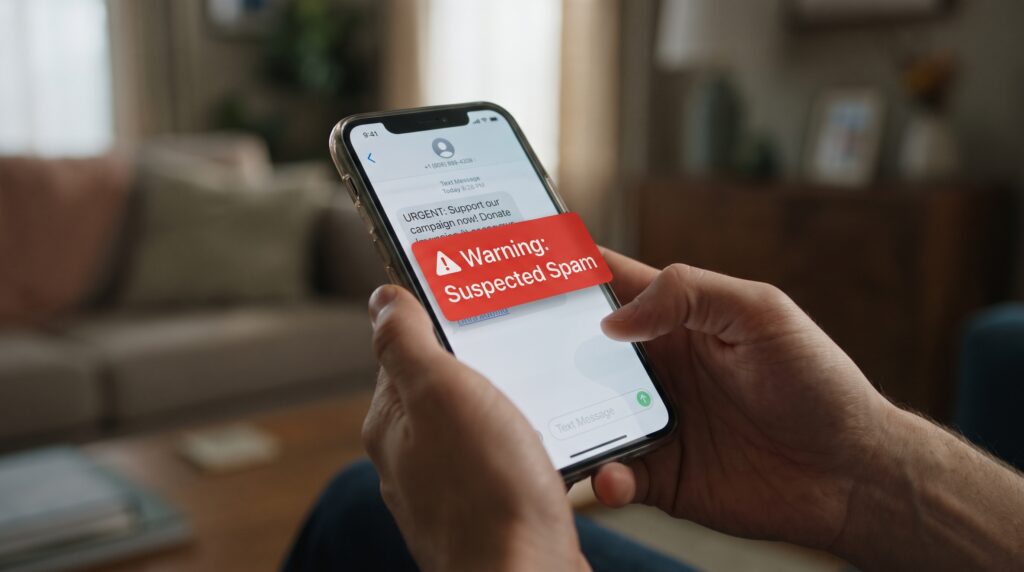
The Unprecedented Avalanche of Political Outreach
The modern election cycle has unleashed an unprecedented wave of political text messages directly onto the mobile devices of millions of citizens. Analysts tracking telecommunications data project that over 60 billion political texts will have been transmitted between 2020 and 2024, representing a staggering 7,000% increase in mobile political outreach since 2018. While many of these communications originate from legitimate campaign committees, this high-volume channel has been deeply infiltrated by malicious actors seeking to exploit voter enthusiasm, anxiety, and political polarization.
The proliferation of these messages is largely facilitated by the regulatory environment surrounding political speech. A common misconception among consumers is that adding a mobile device to the National Do Not Call Registry will halt campaign texts. However, political communications, charitable solicitations, and polling are expressly exempt from this registry due to First Amendment protections. As a result, the barrier to entry for contacting voters is exceedingly low, creating a densely populated ecosystem where legitimate political discourse and outright fraud become difficult to distinguish.
The Psychological Mechanics of “Smishing”
Fraudulent political action committees (PACs) and cybercriminals engineer these text messages to bypass rational decision-making by triggering intense emotional responses. These tactics, operating under the umbrella of “smishing” (SMS phishing), rely heavily on manufactured urgency and fear.
Scammers frequently deploy artificial deadlines, claiming a candidate will suffer a catastrophic loss without an immediate financial contribution. This scarcity mindset forces the recipient to act quickly, overriding natural skepticism. Furthermore, fraudsters exploit authority by spoofing the names of prominent political figures. Advanced operations have even begun utilizing artificial intelligence and voice cloning to impersonate candidates in accompanying robocalls, creating a highly convincing facade designed to extract both funds and personally identifiable information (PII). The financial toll of these tactics is severe, with the Federal Trade Commission (FTC) noting hundreds of millions of dollars lost annually to text-based fraud.
Identifying the Anatomy of a Scam
Political text scams manifest in several distinct variations, each designed to compromise the recipient’s financial security. One prevalent method involves sending unsolicited messages directing voters to cloned donation websites that mirror official campaign pages but are strictly designed to harvest credit card data. Another highly deceptive scheme is the “campaign investment pool,” where victims are promised a guaranteed financial payout if a specific candidate wins the election—an offer federal authorities consistently flag as definitive fraud.
To assist in distinguishing between aggressive but legal campaign outreach and outright fraud, the following indicators should be evaluated:
| Operational Feature | Legitimate Political Campaign | Fraudulent Scam Operation |
| Payment Methods | Accepts standard credit cards via verified, compliant processors. |
Demands wire transfers, cryptocurrency, or retail gift cards. |
| Opt-Out Compliance |
Honors “STOP” replies and ceases communication (mandated by carrier rules). |
Ignores opt-out requests; replying verifies the number is active. |
| Sender Identification |
Includes clear “Paid for by…” disclosures as required by the FEC. |
Obscures the sender; links redirect to unverified, frequently changing domains. |
| Incentives | Solicits donations directly for campaign operations or advertisement buys. |
Offers guaranteed financial returns, sweepstakes, or prizes requiring a fee. |
Regulatory Loopholes and Telecommunications Defenses
The telecommunications industry has attempted to curb spam through 10-Digit Long Code (10DLC) regulations, which require commercial and political senders to register their brands and verify their identities before sending bulk messages. Non-compliant traffic faces heavy filtering and severe financial penalties from cellular carriers.
However, regulatory loopholes persist. While the Telephone Consumer Protection Act (TCPA) restricts the use of automated dialing systems without prior consent, many organizations utilize “peer-to-peer” (P2P) texting platforms. By requiring a human operator to manually click “send” for each message, these platforms legally bypass traditional autodialer restrictions, allowing campaigns—and scammers mimicking them—to flood mobile networks.
Actionable Defense Mechanisms
Individuals seeking to engage politically while protecting their financial assets must adopt proactive defensive measures. Financial contributions should never be initiated by clicking hyperlinks provided in unsolicited text messages. Instead, voters must navigate directly to a candidate’s official website or verify the organization’s legal standing through the Federal Election Commission (FEC) database.
When malicious messages are received, engagement of any kind—including replying “STOP”—can inadvertently signal to scammers that the phone number is active and monitored. The most effective protocol is to forward the fraudulent text message to the number 7726 (SPAM), which prompts cellular carriers to investigate and block the sender’s network routing. Additionally, reporting these incidents to the Better Business Bureau (BBB) Scam Tracker and the Federal Communications Commission (FCC) provides consumer protection agencies with the data necessary to map fraud
“Lorem ipsum dolor sit amet, consectetur adipiscing elit. Ut elit tellus, luctus nec ullamcorper mattis, pulvinar dapibus leo consectetur adipiscing.”
Lorem ipsum dolor sit amet, consectetur adipiscing elit. Ut elit tellus, luctus nec ullamcorper mattis, pulvinar dapibus leo consectetur adipiscing.
Lorem ipsum dolor sit amet, consectetur adipiscing elit. Ut elit tellus, luctus nec ullamcorper mattis, pulvinar dapibus leo consectetur adipiscing.
Lorem ipsum dolor sit amet, consecti Latur adipiscing elit
Lorem ipsum dolor sit amet, conari sec tetur adipiscing elit. Ut elit tellus, luctus nec ullamcorper mattis, pulvinar dapibus.
“Lorem ipsum dolor sit amet, consecte tur adipiscing elit. Ut elit tellus, luctus nec ullamcorper mattis pulvinar.”

Lorem ipsum dolor sitam, consec tilan tur adi piscing elit luctus nectus ara mus vestibulum
Lorem ipsum dolor sit amet, consectetur adipiscing elit. Ut elit tellus, luctus nec ullamcorper mattis, pulvinar dapibus leo consectetur adipiscing.
Lorem ipsum dolor sit amet, consectetur adipiscing elit. Ut elit tellus, luctus nec ullamcorper mattis, pulvinar dapibus leo consectetur adipiscing.
The Hidden Cost of Political Engagement: Navigating the Surge in Fraudulent Campaign Texts
The Tolen Foundation
Disclaimer: All content provided by The Tolen Foundation is for informational and educational purposes only and does not constitute professional legal or certified financial advice. We recommend consulting with a certified accountant or attorney for your specific situation.